As part of the DigiTechPort2030 project, Euro Terminal has been actively exploring practical solutions for greener operations. One important step is the introduction of a new Jungheinrich electric forklift, which joins our existing fleet of electric vehicles. Since Euro Terminal specializes in handling frozen food storage, electric forklifts are not only a sustainability measure but also a necessity for maintaining safe and efficient warehouse operations.
DigiTechPort2030: Euro Terminal has long experience in using electric forklifts. Could you introduce your terminal and explain why electrification is so important for your type of operations?
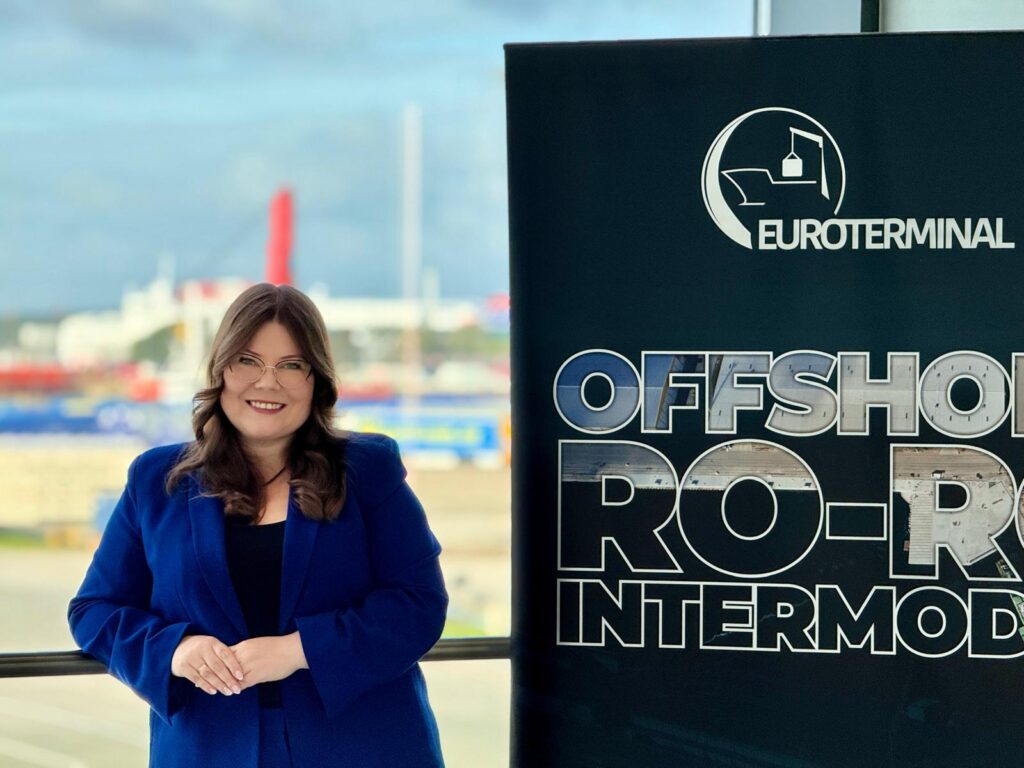
Joanna Morawska: Good morning, my name is Joanna Morawska. In the DigiTechPort2030 project, I represent Euro Terminal, which is a private terminal located in the Port of Świnoujście (Poland) – close to the open Baltic Sea and Szczecin Lagoon, 100 km from Szczecin and 235 km from Berlin – as part of the Baltic-Adriatic Core Network Corridor. Świnoujście is the first Polish port on the sea route leading through the Danish Straits to the Baltic Sea. So I can certainly say that Euro Terminal is a perfect Baltic hub for cargo traffic to and from Central and Eastern Europe. With such a great location, our terminal is a natural choice for multimodal operations between road, rail, sea, and inland waterway transport.
In numbers, Euro Terminal represents over 30 years of experience, 53 hectares of area, 2 basins, 3 cold storage facilities with a capacity of 30,000 tons, plus 30,000 square meters of warehouse space and over 300,000 square meters of open storage yards. In addition, we operate our own locomotive and a 9,000-meter-long railroad siding. Our biggest investment in recent years is a 37-meter-wide Ro-Ro ramp with a load capacity of 700 tons, which is currently the largest Ro-Ro ramp in Poland and, I would venture to say, probably also in the Baltic Sea region. This outstanding project has allowed us to cooperate with a new ferry operator, Finnlines, in Świnoujście, launching a daily connection to Malmö in Sweden last year. We are very proud of our Ro-Ro ramp.
I should also add what kind of cargo we specialize in, because that leads directly to the electric forklifts you asked about. We are dedicated to handling and storing forest products and breakbulk cargo, as well as aluminum, steel, concrete products, and special cargo. In recent years, the most spectacular examples have been the transport of military equipment, including tanks. We have gained significant experience in handling components for wind farms and are constantly developing into a hub for onshore wind turbine components. In my opinion, in Poland we have been pioneers in this type of port operations. As an interesting fact, I’ll add that the longest blade we are currently loading onto a ship is 82 meters long. We consistently receive positive feedback from our clients for working quickly without sacrificing accuracy or cargo care.
However, from the very beginning, Euro Terminal has been a major hub for refrigerated cargo. Our main specialty is frozen fish, and that’s why we have extensive experience using electric forklifts. The reason is that working in cold storage requires the exclusive use of electric forklifts. This is the standard set by regulations. Over time, however, we noticed many advantages of working with electric forklifts, and now we use them not only in cold storage. This is the direction we would like to continue developing in, which is why we took part in the DigiTechPort2030 project, which concerns the decarbonisation and digitalisation of small and medium-sized ports.
DigiTechPort2030: You recently received a new Jungheinrich electric forklift through DigiTechPort2030. Could you share what role this forklift will play in your daily operations and what your expectations are for it?
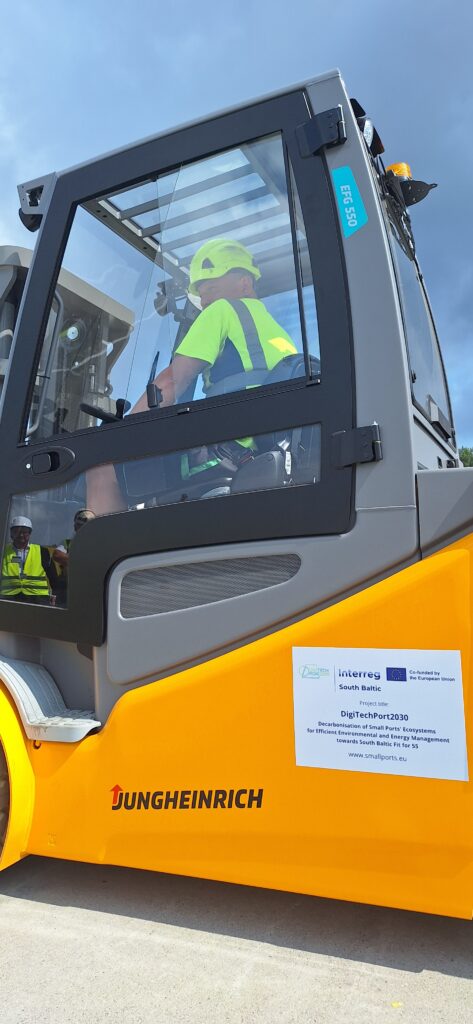
Joanna: Yes, that’s right. On July 2 this year, the manufacturer delivered the electric forklift we had previously ordered. A few days later, it successfully passed inspection and was approved for operation by the Technical Inspection Authority for Transport. The forklift was then fitted with special stickers indicating that it was purchased as part of the aforementioned project, which is co-financed by the Interreg South Baltic Programme, and it was prepared for the arrival of the remaining project partners and invited guests.
During the inauguration ceremony, our distinguished guests toured the terminal, including experiencing the low temperatures in our cold storage facilities firsthand. They then observed a demonstration of the capabilities of the purchased electric forklift, as well as a skills demonstration by one of our experienced operators, Paweł. At this point, I would like to sincerely thank him for a fantastic performance. Guests also had the opportunity to speak with representatives from Jungheinrich and ask questions about the technical aspects of the forklift and its battery.
The next day, without unnecessary delay, our new electric forklift began work. It was assigned to unloading ships carrying frozen fish, and as far as I know, it is doing a great job. As I mentioned earlier, we see many advantages in electric forklifts, which is why we are happy to expand our fleet with such models and assign them to tasks beyond cold storage.
And what are our expectations? Naturally, that the forklift will operate reliably and trouble-free for as long as possible. Does this forklift improve our daily operations? Certainly! It has a double palletizer, which increases ship unloading speed. Additionally, thanks to the two batteries included in the set, the downtime needed to change the battery is a maximum of 10 minutes. For comparison, refueling a diesel forklift requires at least 20 minutes. Perhaps the difference doesn’t seem that big, but I assure you it is in both our interest and the shipowner’s to complete unloading operations as quickly as possible. Every minute counts.
DigiTechPort2030: Since operational data from the forklift will still be analyzed by Szczecin Maritime University, let me ask from a user’s perspective: what features or aspects of this model stand out to you compared to your existing fleet?
Joanna: The double palletizer I mentioned is an excellent feature. We already have a few models in our fleet with a double palletizer, but they are still not the majority.

The forklift also has an ergonomic workstation for greater efficiency, including a heated operator’s cabin with a comfortable seat. Additionally, the folding compact mast provides excellent visibility, which is particularly important if the operator is not very tall. And let’s remember that women also work as forklift operators at Euro Terminal.
We take the safety of our employees very seriously, which is why we wanted this forklift to be equipped with a reversing signal and a LED rotating warning light, which are optional features. In addition, this forklift has a seatbelt interlock system: it displays a warning on the screen if the seatbelt is not properly fastened and limits the forklift’s speed to only 4 km/h.
Another useful feature is a USB port that allows the forklift operator to charge their work mobile phone or tablet – older models don’t have this.
In our fleet, we definitely have more electric forklifts than diesel-powered ones, which I am extremely happy about. Our electric forklifts usually differ in parameters such as lifting capacity, free lift, lifting height, or battery capacity and weight. The forklift ordered as part of the project certainly has the highest lifting capacity and the largest battery capacity, which shortens operating times for the tasks it is used for.
DigiTechPort2030: From your experience, how do electric forklifts improve working conditions and overall efficiency in a frozen food storage environment?
Joanna: As I mentioned earlier, electric forklifts are mandatory for working in cold storage facilities, so there is no question whether or how they improve work in such conditions. At most, we can compare models and offerings from different manufacturers.
From my own observations, electric forklifts are less prone to breakdowns compared to their diesel-powered counterparts. This is due to the smaller number of components that can wear out more quickly – the absence of an internal combustion engine, exhaust systems, and fuel and oil filters means fewer breakdowns. We also don’t need to store fuel or remember to replenish it regularly. Additionally, it’s worth mentioning that electric motors are quieter than diesel ones. Less noise means better comfort for operators, less hearing fatigue, and better communication in the warehouse.
DigiTechPort2030: When you introduce new electric equipment at Euro Terminal, what factors do you consider most important in the decision-making and testing process?
Joanna: In addition to the price-to-quality ratio, we focus on the reliability and trouble-free operation of the equipment, as well as its efficiency and, of course, work safety. An efficient authorized service located as close to us as possible, as well as the response time declared by that service in case of equipment failure, are also extremely significant to us. It’s very important not to have to wait for a service technician for several days and have the equipment out of service for that long.
When establishing the selection criteria for the contractor for our project forklift, in addition to the price and technical specifications of the forklift itself, we naturally inquired about the location of the authorized service center and the declared response time in case of a breakdown. We also greatly appreciate the comments and valuable suggestions from our experienced operators. After all, they know best how a particular model performs in port operations.
DigiTechPort2030: Looking ahead, are there other areas in your terminal operations where you see potential for electrification or further green innovations?
Joanna: Thank you for asking, because I am proud to share our latest investment – photovoltaic panels. Last year, we installed the first solar panels on some of the roofs of our warehouses. Specifically, we installed 1,840 panels, which covered 10% of our annual energy demand. This year, we decided to go a step further and expand our installation with an additional 1,322 panels, which now covers as much as 17% of our annual energy demand. In the summer months, when there are more sunny days, almost 100% of the energy we need for our operations comes from the sun.
Our electric forklifts are charged with this solar energy, which significantly reduces costs compared to fuel prices. Personally, I think it’s a very good path. I also hope that one day we will build energy storage facilities. I should mention that as a private terminal, we installed photovoltaic panels at our own expense, without any subsidies or other support from state funds. This demonstrates how determined Euro Terminal is in its pursuit of becoming a Green Terminal.
The next great step would be an electric crane 😉
DigiTechPort2030: Thank you for your time!
Keep an eye out for future interviews showcasing the DigiTechPort2030 project partners!
Don’t forget to visit us on LinkedIn for more updates.