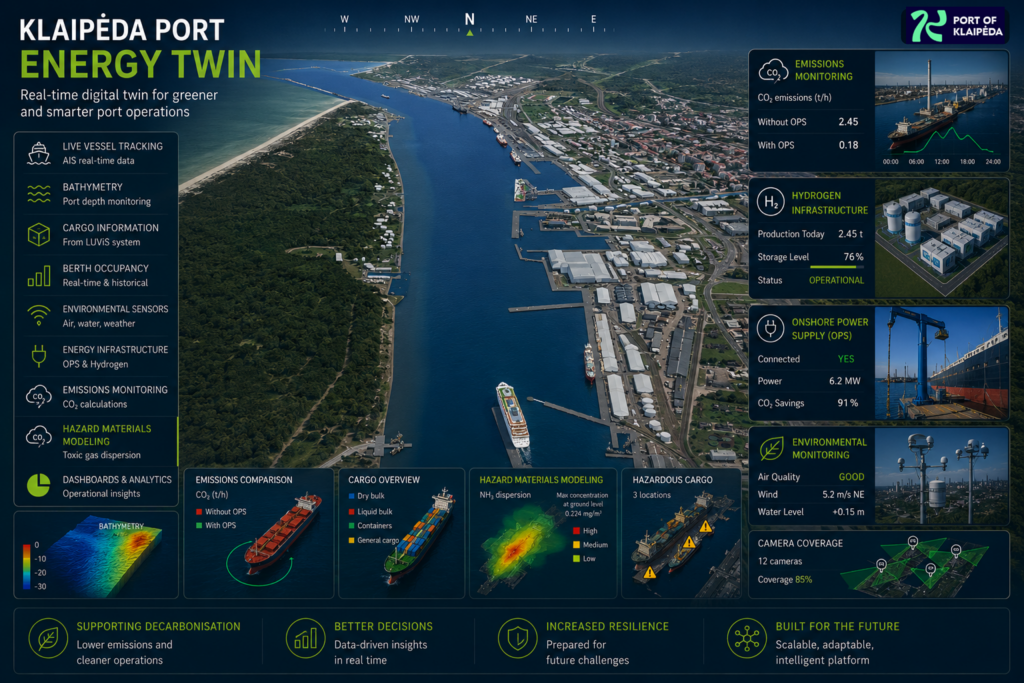
As part of the DigiTechPort2030 project, the Port of Klaipėda developed an Energy Twin to support the port’s green transition and future decarbonisation goals. The objective was not simply to visualise the port in 3D, but to create an environment where operational, energy and environmental information could be brought together and analysed in one place.
To achieve this, a comprehensive 3D Port Digital Twin was first created as the technological foundation. Developed in Unreal Engine, it integrates live vessel movements, bathymetric information, and cargo and vessel data from existing port systems, allowing users to explore port operations within a single interactive environment. Rather than replacing existing information systems, the Digital Twin connects them through a common spatial interface, making complex information easier to understand and use.
Building on this foundation, the Energy Twin extends the platform with capabilities directly supporting the project’s decarbonisation objectives. It integrates Onshore Power Supply (OPS) infrastructure, hydrogen facilities, environmental monitoring, berth occupancy, emission calculations, cargo information and operational dashboards into one connected environment. This enables port users not only to observe ongoing operations, but also to better understand the environmental impact of different operational scenarios and support future energy-related decisions.
For the Port of Klaipėda, one of the key outcomes of the project is that the Energy Twin has become much more than a project deliverable. It has established a reusable digital platform that can continue to evolve together with the port. Future development will focus less on adding new datasets and more on extracting value from the existing ones through advanced analytics, modelling and AI-assisted decision support.
The Port of Klaipėda’s experience demonstrates one practical approach to combining digitalisation and decarbonisation. An Energy Twin does not have to begin with a complex system. It can be developed step by step by integrating existing operational data, gradually expanding its functionality and creating practical value for both port operations and the green transition.