As the European Union continues to tighten environmental requirements, ports across the region are being called to move beyond plans and deliver real, measurable results. The DigiTechPort2030 project is rising to that challenge, and a major new milestone has just been reached at Klaipėda Port.
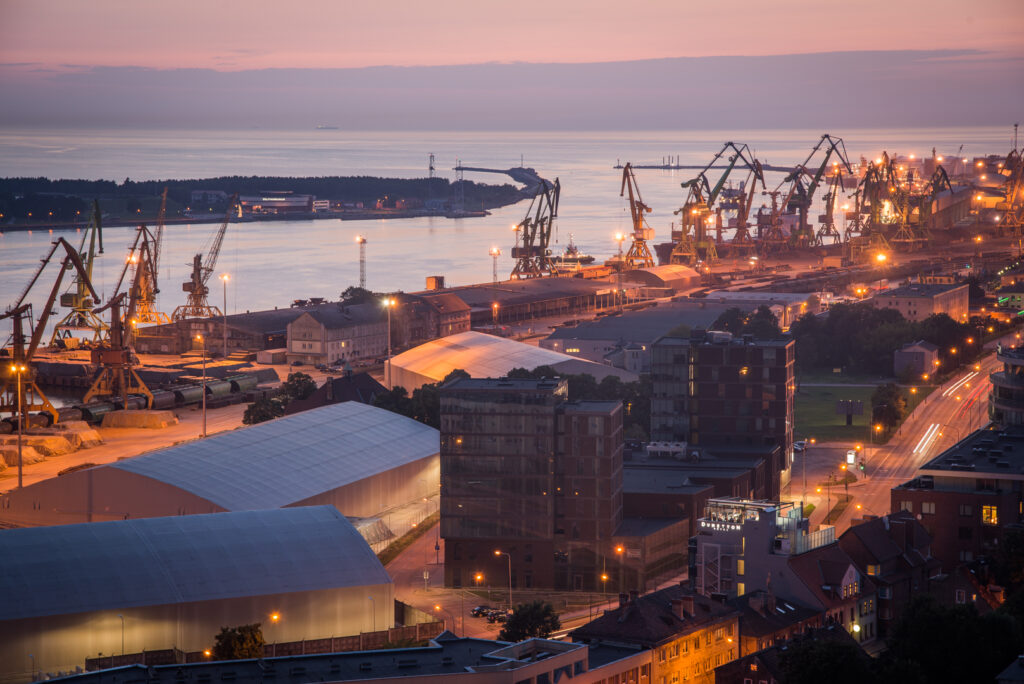
Klaipėda Port’s digital twin, developed as part of the DigiTechPort2030 project under the Interreg South Baltic Programme, has been enhanced with a greenhouse gas (GHG) emission calculation methodology. This methodology was developed by project partner Klaipėda Science and Technology Park (KMTP), in close cooperation with port technology experts and researchers, and is now fully integrated into the digital twin as the foundation for systematic, data-driven monitoring of vessel-related air pollution.
The new methodology marks a clear shift from generalised estimates to precise, real-time emissions monitoring that accurately reflects actual conditions at the port. Based on a validated scientific approach, a calculation algorithm and software code have been developed to enable detailed estimation of air pollutants and GHG emissions from vessels berthed in the port.
“As a DigiTechPort2030 project partner, we have been cooperating with the port for many years. The greatest value is created when scientific knowledge is combined with business needs. Solutions developed in this way have the potential to become an example for the entire region moving towards the green transition.” – Erika Zavackienė, Project Manager, Klaipėda Science and Technology Park
The data collected through this system has significant practical implications. In the future, it may help identify the quays with the highest emissions and support decisions on deploying alternative energy sources, such as shore power (OPS) or hydrogen infrastructure.
Klaipėda Science and Technology Park played a key role in bridging scientific expertise and operational needs, bringing together researchers and port experts to test and implement the solution in a real port environment.
“Working with Klaipėda Port, we see how digitalisation becomes a tool that enables the translation of decarbonisation goals into everyday port operations. Our cooperation has shown that solutions important for both the city and business emerge faster when different competences are combined.” – Erika Zavackienė, Project Manager, Klaipėda Science and Technology Park
“DigiTechPort2030 project enabled not only the first integrated emissions calculation solution developed in-house, but also effective cooperation between different institutions, resulting in a practically applicable solution.” – Algimantas Žygus, Klaipėda Port
This achievement is part of the broader DigiTechPort2030 project goal: transitioning from individual technological tools to a fully integrated port operational planning model. The project’s 3D digital twin now combines real-time data from the local geographic information system (PortGIS) and other port information systems, offering dynamic visualisation of vessel positions, bathymetric data, and critical infrastructure — from quays to hydrogen facilities.
Port digitalisation and decarbonisation are rapidly becoming a necessity across Europe. The work done by DigiTechPort2030 partners demonstrates that when science, technology, and port operations work together, the result is not just innovation – it is practical, working solutions that directly reduce emissions and improve energy efficiency.