How can small and medium-sized ports identify the right priorities for their green energy transition? The DigiTechPort2030 project addresses this challenge with a free online tool that helps ports assess their readiness for change, analyse energy use and CO₂ emissions, and explore potential decarbonisation scenarios.
The transition towards greener port operations requires informed decisions. Port authorities and operators need to understand their current energy consumption, identify opportunities to reduce emissions and determine which technologies and investments are most relevant to their individual circumstances.
To support this process, the DigiTechPort2030 project has developed the Green Energy Transition Tool – a practical, data-driven resource designed specifically for small and medium-sized ports.
“Smaller ports face greater challenges when selecting appropriate technologies and deciding which measures would have the greatest impact in their specific circumstances and justify future investments. Our tool allows ports to start their assessment using their own data and compare possible transition scenarios. This is particularly important for smaller ports, as general industry trends often primarily reflect the situation of larger ports,” says Erika Zavackienė, DigiTechPort2030 Project Manager at Klaipėda Science and Technology Park.
Assess your port’s readiness for the green transition
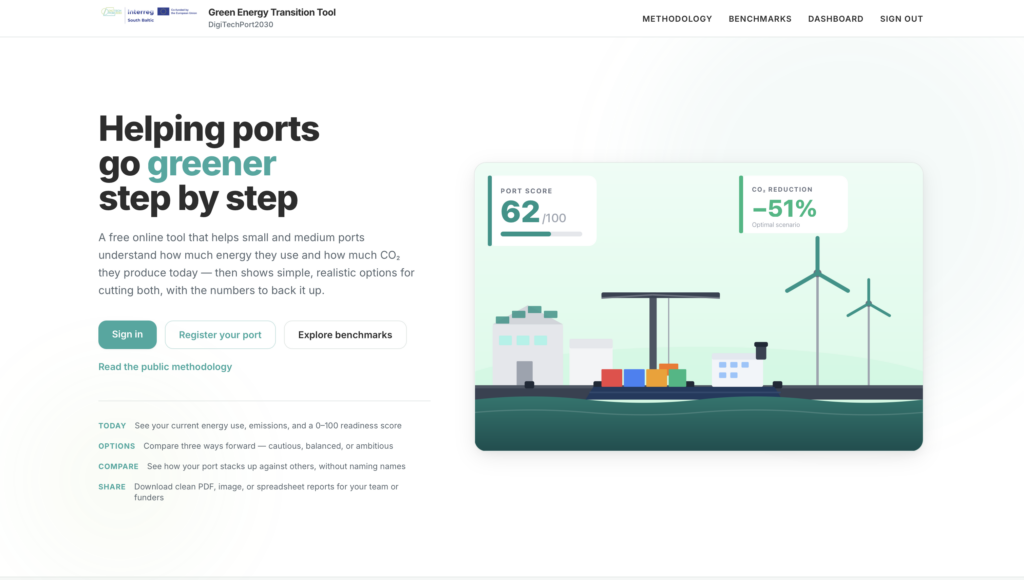
The Green Energy Transition Tool enables port operators to carry out an initial assessment using port-specific information. Based on the data entered, the tool calculates a green transition readiness score and allows users to model three potential transition scenarios, from more moderate to more ambitious changes.
The assessment covers five areas:
- Strategy
- Management
- Infrastructure
- Operational and equipment readiness
- Engagement of external stakeholders
The tool also supports the exploration of different decarbonisation pathways, including the electrification of cargo-handling equipment, integration of renewable energy, shore-side electricity supply for vessels, smarter energy management and preparation for alternative fuels.
Results include projected changes in energy consumption and CO₂ emissions, key operational indicators and preliminary economic assessments. These insights can help ports identify potential priorities and better understand the implications of different transition options.
Developed and tested using real port data
The Green Energy Transition Tool builds on the research, practical experience and pilot activities carried out within DigiTechPort2030. Project solutions were developed and tested using real port operational, energy consumption and telemetry data.
Four pilot cases provided practical insights into different approaches to port decarbonisation:
- Euro-Terminal Świnoujście, Poland: electrification of cargo-handling equipment and energy consumption.
- Port of Karlshamn, Sweden: electrification of cargo-handling equipment and energy consumption.
- Port of Klaipėda, Lithuania: application of a digital twin to vessel arrivals and port processes.
- Port of Elbląg, Poland: integration of solar energy.
By examining different port environments and operational needs, the project aimed to develop approaches that could be useful beyond the pilot sites, supporting other small and medium-sized ports across the South Baltic region and Europe.
Turning data into better-informed decisions
The need for practical, data-driven support was also highlighted by an earlier DigiTechPort2030 survey involving 81 organisations from maritime transport, energy, ports and related sectors. The findings showed that only slightly more than half of respondents had a long-term strategy incorporating sustainable development and the transition to green energy.
The Green Energy Transition Tool responds to this challenge by helping ports move from general ambitions to an initial assessment based on their own circumstances.
Its methodology is publicly available and explains how energy consumption, emissions and readiness indicators are calculated. Ports can also anonymously compare their results with aggregated indicators from other ports using the system.
The tool is intended to support the exploration of potential scenarios and inform decision-making. It does not replace detailed technical, financial or feasibility assessments, which are recommended before investment decisions are made.
DigiTechPort2030
Part of the Green Energy Harmonisation Toolbox
The Green Energy Transition Tool forms part of the Green Energy Harmonisation Toolbox, developed within DigiTechPort2030 to provide practical resources for the green energy transition of small and medium-sized ports.
The toolbox brings together the results of the project’s activities, with the aim of making relevant methods and solutions accessible to both pilot ports and other ports seeking to improve their environmental performance.
The Green Energy Transition Tool is free to use and does not require specialised software. Port operators can use it to conduct an initial assessment, explore possible pathways and identify areas for further investigation.
Explore the Green Energy Transition Tool
The tool, its methodology, DigiTechPort2030 research reports and other project results are available on this website, under “Path for Decarbonisation”.