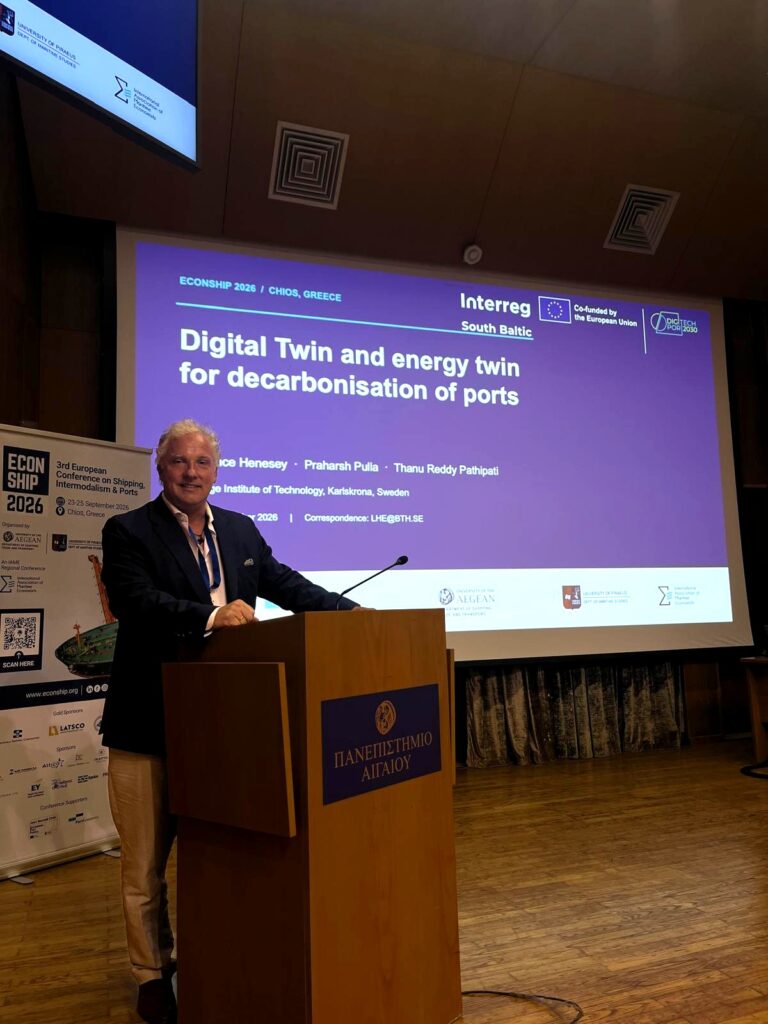
From 23–25 September, the DigiTechPort2030 team took part in ECONSHIP 2026 in Chios, Greece – the 3rd European Conference on Shipping, Intermodalism & Ports, hosted under the theme “Navigating to the Maritime Future: Competitive, Sustainable, and Resilient Maritime Supply Chains” and organised as an IAME Regional Event.
Lawrence Henesey (Blekinge Institute of Technology) presented the paper “Energy Twin technology for improved performance and decision making for Ports: A Case study from the Baltic,” co-authored with Alexandr Silonosov (BTH) and Dr. Laima Gerlitz (Hochschule Wismar) — work carried out as part of DigiTechPort2030.
What the study looked at
Small and medium-sized ports (SMSPs) around the Baltic are increasingly shifting to battery-electric cargo-handling equipment, but the tools used to plan and manage that transition often don’t capture how equipment, terminal operations, and energy systems actually interact. The paper proposes an “Energy Twin” — a digital twin focused specifically on modeling and validating energy use — and, crucially, tests it against real operational data rather than assumptions alone.
Using a discrete-event simulation built in CHESSCON®, the team modeled a break-bulk cargo scenario based on real terminal data from the EU DigiTechPort2030 pilot: 2,000 cargo units handled by four battery-electric forklifts over roughly 55 hours. They then validated the simulation against real telemetry from a Jungheinrich Fleet Management System, comparing simulated battery state-of-charge, charging cycles, and energy consumption against what the equipment actually reported in the field.
A few things that stood out
- The simulation and the real-world FMS data didn’t fully agree — the simulated energy demand and charging rate both came in higher than what the fleet management system observed, a useful reminder that simulation fidelity has to be earned through validation, not assumed.
- Perhaps the most interesting finding: battery consumption turned out to be only weakly tied to how much weight the forklifts were carrying. It was driving behavior, lifting frequency, idle time, and environmental conditions that drove energy use far more than load weight — challenging a common simplifying assumption in energy modeling.
- Fleet utilization in the scenario was around 24%, pointing to excess capacity relative to demand — exactly the kind of operational insight an Energy Twin is meant to surface for terminal planners.
What’s next
The team plans to bring in a second Fleet Management System dataset for cross-validation, and to develop standardization protocols so Energy Twins can work across the different data formats and sensor setups used by different equipment manufacturers — a key step toward making this approach generalizable for green port operations across the South Baltic region and beyond.
Congratulations to Lawrence, Alexandr and Laima for bringing this Work-in-Progress research to the ECONSHIP community!